-snip-
The problem is that the tech works and once you know the tech works from personal experience you then have a big reason to want the DM b/s to be true. It's also hard to explain without a good long hard look how it is that the subject can hold so much promise and yet the management can be so corrupt. It doesn't add up and is therefore easy to reject.
I'll tell more of my story in coming posts.
Underlining, above, added.
Are you sure that you don't mean that
some of tech works?
An example: From 1968 to 1978, Hubbard's instructions for OTs that have somatics was: "HE NEEDS DIANETICS."
During the same time period, Hubbard explained that only 2% go Clear on Dianetics and, then, it's only keyed-out Clear, not real Clear. These two percent were instructed to do PP, R6EW, and the CC to become
real Clears.
In 1978, Hubbard announced that auditing OTs on Dianetics was "deadly," and that Dianetics routinely makes Clears, and - he had just discovered - had always been making them all these years, and that keyed-out Clear
was Clear. Period. With no elaboration.
The newly announced Dianetic Clears were to skip PP, R6EW, and CC and go directly to OT 1.
At the time, Hubbard had become interested in acquiring the bank accounts and property of the Missions, and the Missions were accused of "holding on to [the newly recognized] "Dianetic Clears," which were supposed - now - to exit the Missions and report "up lines." But that's another story.
Former C/S International and Class 12, David Mayo.
If you haven't seen this 1990 article by David Mayo on Clear:
http://www.ivymag.org/iv-01-02.html, it's worth a look.

An excerpt:
"It was PR and marketing considerations that led Hubbard to decide that certain people were 'clear' at a certain point."
So, I would say that some of the tech works. But all of it?
An old re-post. If you haven't seen this, maybe it will be of some use.
The cheese
And the trap
___________
Auditing is an English language word.
Amongst synonyms listed by Merriam-Webster are: "Examination, going-over, review, scan, scrutiny, view."
The Latin root word means, "a hearing," or "to hear."
Scientology has adopted the word, "auditing."
Those introduced to auditing by Scientologists, both inside and outside the CofS, are often told the above definitions are descriptive of Scientology auditing.
_________________
IMO, it's important to discern between the "bait" portion of auditing where one is primarily
asked, and the "switch" portion of "auditing" where one is primarily
told.
"
This is a cold blooded and factual account of your last sixty trillion years," from 1952's '
What to Audit' (a.k.a. '
History of Man') found Hubbard
telling others the contents of their minds, but it was premature "mind grope," just as the early 1950s e-meter reactions projected on the wall with shadows, while the audience went "ooh!" and "ahh!", was premature "Your e-meter will tell you"-ism, and the 1951 "no rights of any kind" was premature SP Doctrine, and the 1951 "dispose of quietly and without sorrow" was premature Fair Game Law and premature disconnection - disconnection in its most extreme form.
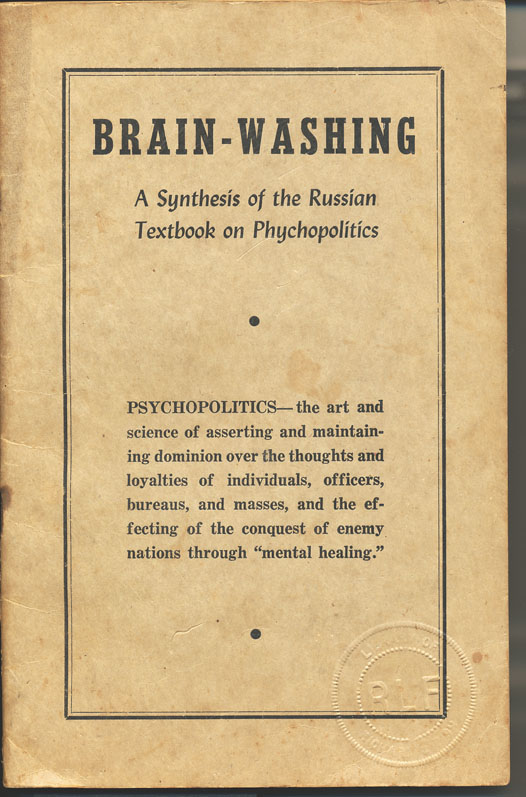
It was too early for the implementation of these ideas on the still small, fragile and tentative membership. That would need to wait for a decade, as would Hubbard's implementation of most of the ideas outlined in the "enigmatic" (fraudulent) "Russian Textbook on Psycho-politics."
http://exscn.net/content/view/178/105/index.html
In the mean time, Hubbard surrounded himself with those excited about his much advertised vision of a better world, and excited about the full releasing of spiritual ability.
Hubbard liked to write and he liked to lecture, and he had a knack as a practical psychologist. He drew on the ideas and innovations of the most creative of those around him, and drew on his own knowledge of abreaction (catharsis, "get it [buried thoughts and emotions] off your chest") therapy, of Alfred Korzybski's General Semantics, and of Aleister Crowley's Magic(k). Hubbard re-worked the (four 'letters' - ingredients - of the) Kabbalistic 'tetragrammaton', and it became his 'Four Conditions of Existence'. Hubbard rewrote Crowley's 'Naples Arrangement' and it became his 'The Factors'. He borrowed Crowley's idea of a multiplicity of infinite minds and further excited Scientologists with that notion. None of these were original with Crowley, who was as much a relay point as was Hubbard. Yet, unlike Crowley, Hubbard would eventually incorporate the methods of psychological warfare into his system, and use those methods, not only on his perceived enemies, but on his own followers.
And when he finally - in the mid 1960s - unleashed, mostly covertly, the psychological warfare methods of the "Russian Textbook" on Scientologists, he also returned to fully utilizing those ideas he had briefly tested more than a decade earlier. He gave Scientologists a past, he gave them a future, he told them the contents of their own minds, and made it plain that only HE knew and others were going to be
told.
Hubbard had written confidentially of the importance of "using enemy tactics," and would even use those "enemy tactics" on his own loyal followers. He had written of psychiatrists in August 1963:
"
Psychiatry is authoritarian and tells the person what's wrong with him, often introducing a new lie. Scientology finds out what's wrong with the person from the person."
Soon to follow would be the secret and very serious, and very dangerous, and vital to your survival "Clearing Course," "OT 2" and "OT 3," in which Hubbard would do what he said the psychiatrists did.
Hubbard had done this in 1952, but now it was formalized and institutionalized, and a senior part of the doctrine of Scientology doctrine.
From Hubbard, 1966:
"
Many persons experience unreality at the start of[implant]
GPM running [told to you, not asked, by Hubbard through the materials];
this leaves when you see the meter reads."
L. Ron Hubbard, from 1946, from his (private) ''Affirmations':
"
Your writing has a deep hypnotic effect on people and they are always pleased with what you write.
"
Your psychology is advanced and true and wonderful. It hypnotizes people. It predicts their emotions, for you are their ruler."
Despite all this, is there some value in the
simplest application of the definition of auditing? - a definition that predates Scientology.
IMO, yes. However, as such, it is no longer Scientology.
Asking a person, "How ya doing?" and listening attentively, and acknowledging, qualifies as "auditing" by an introductory definition of "auditing," as does asking a person to recall a pleasant experience, listening, and then acknowledging.
Such introductory actions, presented as "auditing" are often what leads a person into Scientology, and causes the person to pursue the Scientology "bait and switch" Grade Chart.
Scientology/Scientology Philosophy/Scientology Doctrine, is sneaky. It wraps itself in positives so as to mislead the unsuspecting.
Not recognizing this mostly benign introductory aspect means not recognizing the "cheese" part of the trap,
and means also not recognizing a main part of Scientology's disguise layer.
Thoroughly describing Scientology is the most dangerous thing that can be done to Scientology.
Scientology uses good people, and uses - sometimes - good ideas, to mislead, to build confidence, and to trap.
A description without noting the above is incomplete, IMO.
The definition of auditing changes as the person descends further into Scientology. At first, auditing is little more than one person talking with another person. At this stage, in and of itself, auditing is, essentially, benign. It may even be beneficial.
This "sells" the person on the idea of "auditing."
Then it becomes something else.
"Auditing" has multiple meanings that, in accordance with Scientology's "gradients of deception" and "bait and switch" pattern, mislead a person onto the Scientology Grade Chart, a Chart that begins with mostly benign actions, and eventually becomes manipulative, "hypnotic," and potentially psychologically damaging.
That's why issuing forth a Bronx cheer,
indiscriminately, on the topic of auditing is helpful to Scientology. Such a Bronx cheer asserts that one of Scientology's - initially benign, and even helpful - enticements, and lead-ins, is entirely without value, which is sometimes simply not so.
Describing Scientology fully means recognizing that there are some twinkling ornaments of light, and (even) truth, wrapped around the black hole of Scientology doctrine.
Hope this helps.


 hang out and relax. The leaving process doesn't happen overnight, although it may seem that way. I guarantee you that in six months you will be much more yourself and your views will have loosened up and emerged, uninfluenced by scn or this board, and you'll find yourself surprised when you look back to now. Enjoy the journey. Looking forward to your stories.







 Marcus!


