What's new

The Little Thread Which Grew - the Apollo '73 to Everything But

Status
Not open for further replies.

lkwdblds

Crusader
I see Carmelo's post, but I don't see Me, Myself and I's post that you are referring to. I'm confused here. :confused2:

I had erroneously thought it was mm&i's post but it was pointed it out to me that Carmelo wrote it in response to mm&i. I went back and changed all references to mm&i as the author to Carmelo. Would it be asking too much if you either deleted this post or changed your post to my revised version. I don't really want the version with the errata still showing on the thread.
Thanks, Lakey
 

FoTi

Crusader
I had erroneously thought it was mm&i's post but it was pointed it out to me that Carmelo wrote it in response to mm&i. I went back and changed all references to mm&i as the author to Carmelo. Would it be asking too much if you either deleted this post or changed your post to my revised version. I don't really want the version with the errata still showing on the thread.
Thanks, Lakey

Done.
 

lkwdblds

Crusader
You are a good poster and we need an opposing viewpoint!

That's OK, I wasn't really addressing anyone in particular and certainly not the freezoners and Indies here, and I'll try not to mess up your thread too much.

It would be sad to see ESMB becoming too safe for wannabe Messiah marketing, I believe they should have the manners to look for their potential market elsewhere and at least give the newly out and the lurkers a chance to find their feet and rid themselves of the cultic nonsense. Replacing one guru with another must only add to the confusion.

Unless ESMB is given a name change to Ex cofs Message Board or similar, I'll continue to consider that ESMB remains primarily for Ex scientologists and behave accordingly.

:happydance:

You are a good poster, we need you here! That is just my personal opinion, others may differ. You seem to be capable of objective writing and are able to express yourself well. What you just wrote is, to me, not bashing but just a valid opposing view. Keep up the good work, such as this post. One thing about you is that you speak with conviction. It is obvious that you believe strongly that what you say is correct. Your opinion is appreciated, at least by me!
 

lkwdblds

Crusader
One minute of "bliss"

I'm in a very good mood right know and wanted to end the evening with a little bit of Mozart.

I have this CD in my car and have been playing it a lot and never paid attention to this one snippet and then about 3 days ago, it grabbed me, and I can't get the theme out of my mind.

The piece is a string quintet, K 614, one of Mozart's last pieces (he wrote 626). The whole 3rd movement is just good sound Mozart chamber music but at 1:46 the part that caught my attention starts and continues to 2:46, exactly 1 minute. To me, that part is very catchy. There is some kind of overtone in it which strikes me as Scottish or Irish. It is a simple melody but he runs it upwards, downwards, backwards and forwards, mathematically and in smooth seamless transitions. Also, of course in the string quartets the interplay between the instruments is delightful.

http://www.youtube.com/watch?v=KyzaYb2M6Mc

I hope someone other than me likes it. That passage I like seems to take a lot of hearings before it grows on you.
Lakey
 
Last edited:
It would be sad to see ESMB becoming too safe for wannabe Messiah marketing

http://books.google.com/books?id=wV...6#v=onepage&q=berkeley messiah noonan&f=false


I've met the Messiah. His name is Allen Noonan. He is head of the One World Family of the Messiah's World Crusade. They ran the Mustard Seed Restaurant on Telegraph Avenue in Berkeley in the late 60s. Their inspiration comes from UFO aliens.

I knew him in the 60s and 770s, when he was my girl friend (at the time)'s father. She, Laurie Noonan has gone on to be (currently) Captain of Flag Staff. This is a picture of us, at one of her brother's wedding in Griffith Park (Terra La La) in the 60s.

picture.php
 

I told you I was trouble

Suspended animation
snipped


I've met the Messiah. His name is Allen Noonan. He is head of the One World Family of the Messiah's World Crusade. They ran the Mustard Seed Restaurant on Telegraph Avenue in Berkeley in the late 60s. Their inspiration comes from UFO aliens.

:spacecraft:

Mmmm, I've always thought if you've met one UFO alien inspired Messiah you've met them all really.

(all fur coat and no knickers).


:giggle:
 

I told you I was trouble

Suspended animation
I get that you want to insult me, for whatever reasons you may have, but that still doesn't answer my question.

My other question is.....Why are you so friggin' hostile?

Work it out for yourself, if it matters.

I'm really not here to answer your questions Foti (in the same way that you don't bother to answer mine).


:eyeroll:
 
SUMMER CAMPAIGN

The preliminary maneuvering has devolved into a textbook tableau. The opposition has substantial entrenched forces. I am positioned with these on my right flank. I have baited their lead elements into a trap on my left flank. They are bivouaced in swampy terrain. I have camouflaged batteries on high ground on three sides. The turkey shoot will commence on or about 25 April. No declaration of war is needed as the lead elements are encamped on the wrong side of the line. This will trigger mobilization, which will form the center. I have been organizing a counter march of irregular forces, infantry and cavalry, and am now training and arming them. As this is a civilian operation, I am arming them with poetry and Guy Fawkes masks. They will then counter march visibly in an attempt to draw reserves in support of the lead elements. Their lead elements are conducting intel and are carefully being fed disinformation. After they discover–to their brief rue and great chagrin–you shouldn’t try to catch the other fellow with his pants down unless you have your own pants up, the irregulars will engage. The two sides will mobilize their main bodies in the center. SOP is to dig in and send out patrols. Their entrenched forces are solid defensively, but entirely absent of mobility. Textbook tactics dictate you then fight on the left flank, skirmish in the center, and skirt on the right flank. Then you pin the entrenched forces with withering fire and sweep en masse around their left flank into the enemy rear and press on Mission Objective. This will collapse their center, and they will fall back into a defensive posture at M. O. It is then a simple task to mop up their right flank, leave their entrenched forces to rot on the vine, surround M. O. and lay siege. They should be ready to strike their colors by Thanksgiving, and we should occupy M. O. by Christmas.
 
Tales of Wells Fargo

http://www.youtube.com/watch?v=WMMjwRghQ2Q

term / opp term ????

whatever


Mon Apr 4, 3:26 pm ET
Cocaine smugglers laundered billions through Wachovia bank
By Brett Michael Dykes

Somehow, the major banks in the United States have gone from serving as the main bulwarks of credit and entrepreneurial pluck to the moral equivalent of a James Bond villain. There were, for instance, the jaw-dropping mortgage frauds detailed by "60 Minutes" just last night. There was last week's report on a group of Citibank-affiliated debt collectors actually killing a customer in Indonesia in a dispute over a credit card bill. And there's the long-running but demoralizing story of the unjustified efforts of large banks to foreclose on active-duty soldiers.

Now comes this: Wachovia Bank -- which merged with the West Coast banking giant Wells Fargo in 2009, in one of the many industry moves sparked by the 2008 mortgage meltdown -- seemingly looked the other way while some of the world's biggest drug lords funneled billions through the bank's holdings. As one federal prosecutor put it, the arrangement "gave international cocaine cartels a virtual carte blanche to finance their operations."

The Guardian reported on Sunday that an extensive investigation by the IRS, DEA and FBI uncovered the porous money-laundering system. The feds found that cocaine smugglers successfully moved tens of billions of dollars in funds through Wachovia accounts using wire transfers, traveler's checks and cash shipments. The paper notes that the flow of cash through the bank began in 2004 -- coinciding with the rise of Mexico's menacing drug gangs and the increased violence on the U.S.-Mexico border. The bank was quietly punished for its actions.

Reports the Guardian:


Criminal proceedings were brought against Wachovia, though not against any individual, but the case never came to court. In March 2010, Wachovia settled the biggest action brought under the US bank secrecy act, through the US district court in Miami. Now that the year's "deferred prosecution" has expired, the bank is in effect in the clear. It paid federal authorities $110m in forfeiture, for allowing transactions later proved to be connected to drug smuggling, and incurred a $50m fine for failing to monitor cash used to ship 22 tons of cocaine.

More shocking, and more important, the bank was sanctioned for failing to apply the proper anti-laundering strictures to the transfer of $378.4bn — a sum equivalent to one-third of Mexico's gross national product — into dollar accounts from so-called casas de cambio (CDCs) in Mexico, currency exchange houses with which the bank did business.
 
Ron Paul's 2012 Presidential Dilema

In the interests of full disclosure: I walked precincts for Barry Goldwater IN 1964 (WHEN I WAS 13), was a Goldwater, William F. Buckley, Jr., Ronald Reagan Republican / Conservative, registered Libertarian, voted for Obama (anybody but Bush or clone)


Ron Paul's 2012 Presidential Dilema
Patricia Murphy – Mon Apr 4, 11:37 pm ET

NEW YORK – His 2008 campaign left the alarmist congressman with a fanatical following, a national organization, and clout. But he's still not sure he wants to run against a Mitt Romney or Tim Pawlenty in 2012—as his son waits in the wings. Patricia Murphy reports.

To the casual observer, Ron Paul might seem like a cross between Elmer Fudd and Chicken Little—a little-looking man, with a littler voice, warning about a coming financial catastrophe so dire that even a conspiracy theorist could dismiss him as over the top.

But after years in which Paul has sounded the alarm alone, financial experts now agree with at least part of his prophesy—that the country is headed toward insolvency if Washington fails to rein in federal spending and significantly reform entitlements, a prospect that's hard to envision as Democrats and Republicans keep squabbling over spare change in the $4 trillion budget.

"We're tinkering around with $20 or $30 billion and the national debt is going up $2 trillion this year? Unbelievable," Paul says during an interview in the Capitol after a day of votes, meetings, and committee hearings.

That tell-it-like-it-is bluntness, along with his libertarian concoction of low taxes, limited government, and isolationist foreign policy, has won the Texas Republican legions of dedicated followers across the country since his run for president in 2008.

It has also given him a platform outside Washington unlike any he has enjoyed during his 20 years on Capitol Hill, including speeches in March to thousands of self-described members of the Paul Revolution in Iowa, New Hampshire, and North Carolina.

“I don’t want power. I want influence. I want to influence ideas.”
"It amazes me," Paul says. "I'm not shocked, but pleasantly surprised. I thought we would get these crowds during the campaign, but they would go away and I could just relax a little bit."

But instead of fading, the enthusiasm for Paul's ruthlessly consistent message of limited government seems only to have grown since he collected a series of single-digit results in the presidential primaries.

In addition to his standing-room-only speeches last month, Paul quietly raised an unusually large chunk of cash—$3 million—in the first quarter of 2011 between his PAC and nonprofit group, more than Mitt Romney or Michele Bachmann raised with their PACs and campaigns.

And unlike the other 2008 also-rans, whose organizations wound down soon after the ballots were counted, the operation around Ron Paul has ballooned from a cult-like presence on the campaign trail to a national infrastructure bordering on a cottage industry.

Paul now runs or is affiliated with a college campus outreach organization with 200 chapters, a leadership PAC, a foundation, and a national grassroots campaign with 17 staff, 10 consultants, 17 official state affiliates, and volunteers in all 50 states.

Even with his ready-made base, Paul says he's still torn about moving forward on another White House run. "I'm very reluctant," he says. "It's a tough job and I know what's involved."

Weighing his options for the next presidential cycle is a long way from Paul's first run for Congress in 1974, when the Pennsylvania-born OB-GYN ran in a heavily Democratic district along the Gulf Coast to protest the decision to remove the dollar from the gold standard. "I just wanted to get it off my chest. I was very confident I wouldn't have to worry about winning," he says.
But he did win in 1978, and went on to serve in Congress until 1984, when he left to mount a losing Senate race against Phil Gramm. After running for president in 1988 on the Libertarian ticket, he returned to Congress for a second tour in 1997.

Although he has remained mostly cordial with his fellow Republicans, much of Paul's time in the House has been spent casting votes that make members of both parties more than a little uncomfortable.

He has voted for Second Amendment protections, but against the Patriot Act and the Iraq War. He has voted against every tax increase, congressional pay raise, and unbalanced federal budget put forward by both parties' appropriators, but has also railed against a federal ban on gay marriage, saying that the government has no role in regulating relationships.
His literal approach to limited government has earned him groans from some fellow Republicans, but his growing national base has kept him at least nominally in the fold with GOP leaders who want the Paul people inside their tent.

"Odd duck, huge following," says one leadership aide, neatly summing up Paul's role in the caucus.

"Ron Paul is seen as a man who marches to his own drummer," Rep. Mike Pence (R-IN) said carefully after a Capitol Hill Tea Party rally, which Paul did not attend. "On a personal level, I think he enjoys the respect and affection from members of the Republican caucus."

Later, Rep. Louie Gohmert, a fellow Texas Republican, jumped, unprompted, to Paul's defense. "I know there are some Republicans that are concerned about the Ron Paul influence in our party. But when I go to college campuses and see young people who have heard Ron's position that we've got too much government, how can that not be a healthy thing?"

Paul's aides say that people under 30 are the fuel behind his following, which includes Goldwater Republicans, libertarians, and, frankly, some pot-smokers drawn to Paul's call to end the government's war on drugs. A conversation with Paul's supporters often reveals a personal devotion to the man usually reserved for a family member or best friend.

"I hate to call him a politician," says Brady Nemeth, a North Carolina State student who helped organize Paul's recent speech on campus. "Policy-wise, he has just opened me up to the idea of liberty, both economic and social. It changes my outlook and perspective about how I should be living my life."
Bonnie Kristian interned for Paul's 2008 campaign and now works at Young Americans for Liberty, which grew out of the Ron Paul student movement. "We've grown up with nothing but war and debt and abuse of our civil liberties. It's not very hard for me and others in my generation to figure out that the two major parties don't have our best interests in mind. Ron Paul's message is different."

One intriguing twist in the saga is the emergence of his son Rand, the newly elected senator from Kentucky—and his father's new roommate in a condo outside Washington. The younger Paul has assumed the role of the stickiest thorn in the side of the Senate's GOP leadership, and after just two months is already testing the presidential waters with trips to Iowa and South Carolina. Rand Paul, who campaigned for his dad in 2008 and is close with the whole operation, would defer to him on the White House front. Still, he recently made this prediction: One of the Pauls will be on the presidential ballot in 2012.

Ron Paul says his decision will depend on the response he gets as he travels around the country, and the health of the economy. Jesse Benton, a top aide to Paul, said the congressman will decide "in early summertime, perhaps sooner," but the response so far has been light years away from 2008. "Doors that would have been closed to Ron three years ago are now friendly and open," he says.

Operatives in Iowa and New Hampshire say that Paul has a real following, but it is hard to imagine him beating a Romney or Tim Pawlenty. Then again, winning at partisan politics has never been the point for Paul.
"I don't want power," he says. "I want influence. I want to influence ideas. So really, my goals are completely different."

Patricia Murphy is a writer in Washington, D.C., where she covers Congress and politics. She is a graduate of Vanderbilt University and the Columbia Graduate School of Journalism.

Like The Daily Beast on Facebook and follow us on Twitter for updates all day long.

For inquiries, please contact The Daily Beast at [email protected].
 
We can all be Messiahs

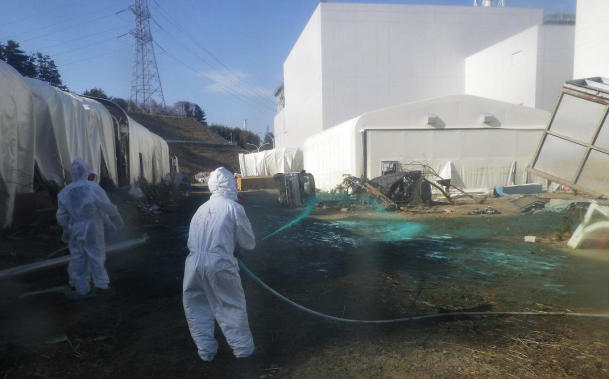
AP110401022857.jpg


Japanese nuclear plant worker discusses choice to sacrifice his life
By Brett Michael Dykes


As Japan continues to grapple with catastrophic radiation leaks at the quake-damaged Fukushima Daichii nuclear complex, the plant's remaining workers have shown heroic dedication in the face of a task that amounts to a likely suicide mission.

The global audience following the Japanese nuclear drama has learned a little about these selfless heroes. But some of the most basic questions about them--who they are and what has motivated them to make the ultimate sacrifice--have gone unanswered. Now, however, the Agence France Press reporter Kimi De Freytas has published an interview with one of the Fukushima workers that sheds considerable light on how they understand their mission--and how they are holding up under under the extraordinary, mortal stress they are facing.

Hiroyuki Kohno, a 44-year-old plant worker who's been employed in the nuclear industry since he was a teenager, promptly answered the emergency call issued by his employer, a subcontractor for the Tokyo Electric Power Company. Shortly after last March's devastating earthquake and tsunami produced a power outage at the facility, Kohno's employers sent out an all-hands appeal via email.

"Attention. We would like you to come work at the plant. Can you?" De Freytas reports the email read. Kohno, who has worked at the Fukushima facility for the past decade, said he knew what the implications of heeding the call would be.

"To be honest, no one wants to go," Kohno told De Freytas. "Radiation levels at the plant are unbelievably high compared with normal conditions. I know that when I go this time, I will return with a body no longer capable of work at a nuclear plant."

Kohno told De Freytas that as a single man with no children, he felt obligated to answer the call and join the team that the media has dubbed the "Fukushima Fifty." Better that he face the risk, he explained, so as to spare his colleagues who have dependents counting on them. Besides, he added, the workers in the plant are his brothers and sisters, and he feels an allegiance to them.

"There's a Japanese expression: 'We eat from the same bowl.' These are friends I shared pain and laughter with. That's why I'm going," he explained to De Freytas.

Other workers among the Fukushima Fifty have apparently discussed the dire prospects ahead fairly openly. As the unidentified mother of a 32-year-old plant worker explained in a tearful phone interview with Fox News, "My son and his colleagues have discussed it at length and they have committed themselves to die if necessary to save the nation." Meanwhile, plant officials have sought to supplement the ranks of workers seeking to contain the spread of radioactive contamination from the facility with workers known as "jumpers"—contract employees who agree to complete designated tasks before fleeing in the hopes that they can shun sustained radioactive exposure. Workers in the "jumper" corps are being offered as much as $5,000 a day, Reuters reports—and many are still turning the offers down.
While the fate of Kohno and his fellow workers remains uncertain, their fellow citizens are already determined to commemorate their heroism.

(Photo of Fukushima plant workers trying to cool reactor: Tokyo Electric Power Co./AP)
 

Terril park

Sponsor
AP110401022857.jpg


Japanese nuclear plant worker discusses choice to sacrifice his life
By Brett Michael Dykes


As Japan continues to grapple with catastrophic radiation leaks at the quake-damaged Fukushima Daichii nuclear complex, the plant's remaining workers have shown heroic dedication in the face of a task that amounts to a likely suicide mission.

The global audience following the Japanese nuclear drama has learned a little about these selfless heroes. But some of the most basic questions about them--who they are and what has motivated them to make the ultimate sacrifice--have gone unanswered. Now, however, the Agence France Press reporter Kimi De Freytas has published an interview with one of the Fukushima workers that sheds considerable light on how they understand their mission--and how they are holding up under under the extraordinary, mortal stress they are facing.

Hiroyuki Kohno, a 44-year-old plant worker who's been employed in the nuclear industry since he was a teenager, promptly answered the emergency call issued by his employer, a subcontractor for the Tokyo Electric Power Company. Shortly after last March's devastating earthquake and tsunami produced a power outage at the facility, Kohno's employers sent out an all-hands appeal via email.

"Attention. We would like you to come work at the plant. Can you?" De Freytas reports the email read. Kohno, who has worked at the Fukushima facility for the past decade, said he knew what the implications of heeding the call would be.

"To be honest, no one wants to go," Kohno told De Freytas. "Radiation levels at the plant are unbelievably high compared with normal conditions. I know that when I go this time, I will return with a body no longer capable of work at a nuclear plant."

Kohno told De Freytas that as a single man with no children, he felt obligated to answer the call and join the team that the media has dubbed the "Fukushima Fifty." Better that he face the risk, he explained, so as to spare his colleagues who have dependents counting on them. Besides, he added, the workers in the plant are his brothers and sisters, and he feels an allegiance to them.

"There's a Japanese expression: 'We eat from the same bowl.' These are friends I shared pain and laughter with. That's why I'm going," he explained to De Freytas.

Other workers among the Fukushima Fifty have apparently discussed the dire prospects ahead fairly openly. As the unidentified mother of a 32-year-old plant worker explained in a tearful phone interview with Fox News, "My son and his colleagues have discussed it at length and they have committed themselves to die if necessary to save the nation." Meanwhile, plant officials have sought to supplement the ranks of workers seeking to contain the spread of radioactive contamination from the facility with workers known as "jumpers"—contract employees who agree to complete designated tasks before fleeing in the hopes that they can shun sustained radioactive exposure. Workers in the "jumper" corps are being offered as much as $5,000 a day, Reuters reports—and many are still turning the offers down.
While the fate of Kohno and his fellow workers remains uncertain, their fellow citizens are already determined to commemorate their heroism.

(Photo of Fukushima plant workers trying to cool reactor: Tokyo Electric Power Co./AP)

More apt we can all be heroes.

I consider this the most important news story currently. Its not talked of much despite having access to 20 or so news services including Al Jazerra
via sky TV.

Earlier I was worried that one reactor would go wrong and all 6 could no longer be worked on and all could spill their guts out. Maybe could still happen. These heroes are concentrating on saving Japan, but they are also potentially saving all our asses. Then there is reactor 3 with plutonium with a half life of a VERY long time. They have reluctantly sent contaminated water to the sea where there is 4000 times the allowed radioactive iodine content.
Such desparate measures are taken because much more drastic action could occur.

My postulates have been with these very brave workers since the beginning.
 
Status
Not open for further replies.
Top